 How-to
How to Choose Interactive Entertainment for Your Team
Quick Summary
Interactive entertainment gives a team a shared challenge to solve together, so every person has a role and a reason to speak up. Unlike a standard team dinner, it lets quieter staff and new hires take part without relying on small talk.
- Active play lets everyone take part at once, not just the loudest voices
- Teams learn to give specific instructions, confirm roles and adjust mid-task
- Measure success with participation rates, post-event surveys and a follow-up check
- Match the activity to the event goal, group size and comfort levels
- Ask each provider for an itemised written quote to compare options fairly
Table of Contents
- How to Choose Interactive Entertainment for Your Team
- Why Interactive Entertainment Works Better Than a Standard Team Dinner
- The Benefits of Team-Building Activities for Engagement and Communication
- Matching Interactive Activities to Your Team's Dynamics and Comfort Levels
- Booking Your Next Corporate or Team Outing in Rochester, MN
- Frequently Asked Questions
How to Choose Interactive Entertainment for Your Team
Last Updated: November 14, 2026
Why Interactive Entertainment Works Better Than a Standard Team Dinner
A team dinner gives people a meal and small talk. Interactive entertainment gives them a shared challenge to solve together.
A dinner rewards the loudest voices and people who already know each other. A game gives every person a role, a score and a reason to speak up.
- Everyone moves at once, so no one sits silently at the end of the table
- Quiet staff get a clear task that does not depend on small talk
- New hires meet colleagues through play instead of forced introductions
Research from 2024 study on interactive technologies and team effectiveness suggests interactive tools can have positive effects on how teams function. That is the core reason we recommend active play over a passive meal.
The Benefits of Team-Building Activities for Engagement and Communication
The useful question for a Rochester, Minnesota team is how those benefits show up, and how you would know afterward. Our guide to what makes a team event work covers the key elements that separate effective outings from forgettable ones.
Engagement comes from a live task, not a passive one. With a scoreboard, timer, or mission, attention stays on the group instead of drifting to phones.
Communication improves because the game forces specificity. In a tactical match or timed challenge, vague instructions fail fast. Teams learn to call out plans, confirm roles, and adjust mid-task.
Relationships form around shared memory. Coworkers who solve a challenge together have a reference point that small talk rarely produces. That matters for breaking down silos between departments that normally interact only through email or tickets.
The research base is real but should be read carefully. A 2024 review of team-building interventions found improvements in team functioning, particularly cohesion, according to research on team-building interventions and cohesion. Treat that as directional support, not a guarantee for your specific group.
How to tell whether it worked. Do not rely on a general feeling that everyone had fun. Use a few simple measures:
- Participation rate: what share of invited employees attended and took an active role
- A short post-event survey on whether people felt included and talked to someone new
- A follow-up check two to four weeks later on whether cross-team communication changed
- Voluntary repeat interest: whether people would attend the next outing
Matching Interactive Activities to Your Team's Dynamics and Comfort Levels
Choosing an activity is a matching problem, not a popularity contest. The strongest Rochester, Minnesota team outings fit the group in front of you, its size, comfort levels, schedule, and goals, rather than the activity that looks best in a photo.
1. Start with the event goal. Welcoming new hires, rewarding a finished project, and rebuilding trust after a hard quarter call for different formats. A relaxed social outing favors low-pressure play; a goal-focused session favors a mission with clear roles.
2. Size the group to the format. Larger groups can be split into squads or heats to keep wait times manageable.
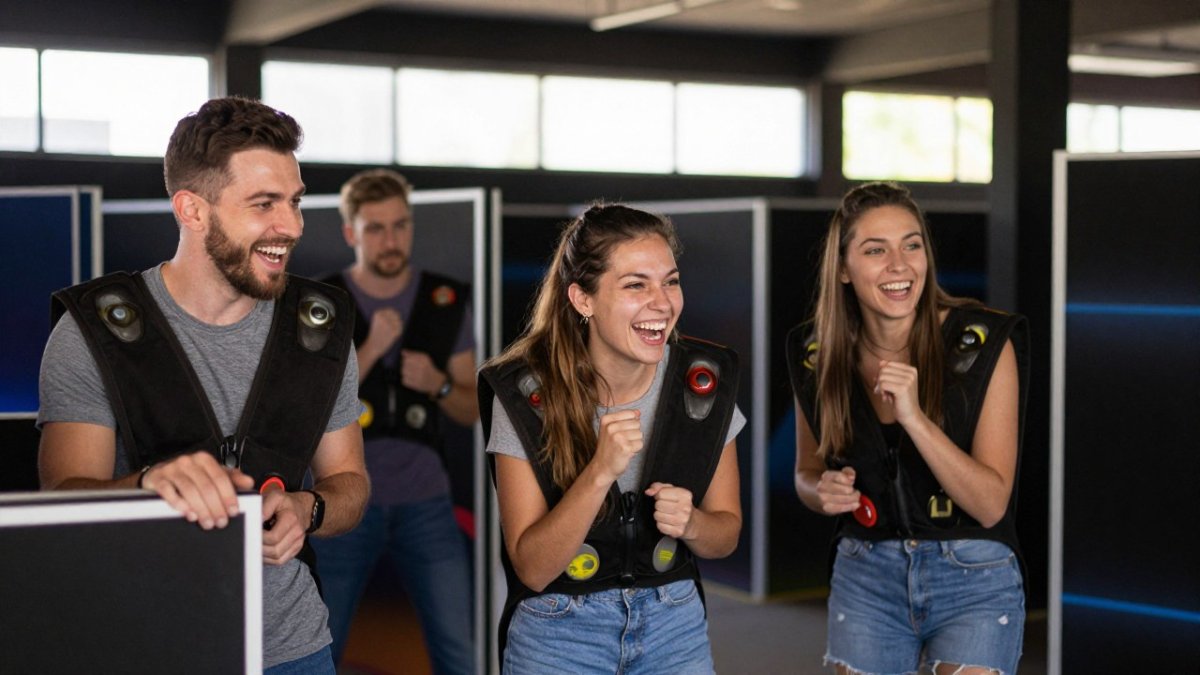
3. Match intensity to comfort levels. Ask up front rather than assuming. A sales team may want a fast tactical match, while a mixed group may prefer mini golf, interactive darts, or a trivia-style challenge. Offer at least one lower-intensity option so no one is forced into physical play.
4. Plan for accessibility and inclusion. Confirm mobility needs, sensory sensitivities, language differences, and whether anyone prefers noncompetitive participation.
5. Fit the schedule and space. Confirm how long the activity runs, setup and transition time, and whether the venue handles your headcount comfortably.
6. Understand the cost drivers. Pricing for group entertainment typically depends on headcount, session length, staffing, equipment, venue, and food and beverage if included. Ask each provider for a written quote that itemizes those factors so you can compare options fairly on the pricing page.
7. Build a contingency plan. Weather, illness, and schedule conflicts happen. Ask whether a booking can be rescheduled, what the cancellation terms are, and whether a lower-intensity backup activity is available.
For a tactical option, our Tactical Laser Tag is available. Interactive darts and indoor mini golf are also available. Larger groups can review our birthdays and group packages.
The steps below summarise how to match an activity to your group before you book.
| Step | What to do | Note |
|---|---|---|
| 1. Start with the event goal | Decide if the outing welcomes new hires, rewards a project, or rebuilds trust | Goal sets the format |
| 2. Size the group to the format | Split large groups into squads or heats | Keeps wait times manageable |
| 3. Match intensity to comfort | Ask up front; offer at least one lower-intensity option | No one forced into physical play |
| 4. Plan for accessibility | Confirm mobility, sensory, language and participation needs | Check before booking |
| 5. Fit schedule and space | Confirm run time, setup, transitions and headcount fit | Venue must handle the group |
| 6. Understand cost drivers | Ask for an itemised written quote | Headcount, length, staffing, equipment, venue |
| 7. Build a contingency plan | Check rescheduling, cancellation terms and backup options | Covers weather and illness |
Booking Your Next Corporate or Team Outing in Rochester, MN
Planning a team outing in Rochester is simpler when you decide the goal first: welcoming new hires, rewarding a project, or simply giving people a fun afternoon together. Once you know the goal, choose the activity that fits it.
Here is a simple way to plan:
- Confirm headcount and the date
- Pick one or two activities that match your team's comfort level
- Compare options on the pricing page before you commit
- Reach out through the contact page to plan your event
Groups looking to book can also explore our birthdays and group packages for larger outings. Interactive entertainment works best when the plan is clear and everyone knows what to expect.
Frequently Asked Questions
How do interactive activities help teams communicate better?
Interactive activities put coworkers in situations where they must coordinate in real time, such as calling out plays in a laser tag match or working through a team trivia round. Those moments encourage people to talk across departments and seniority levels they normally avoid. Pricing and availability depend on group size and dates, so check the 507 Social website for current options or request a quote.
What interactive activities work well for a corporate group?
Groups often choose activities that are easy to learn and let everyone take part at once. Tactical laser tag, interactive darts with multiple game modes, and indoor mini golf all work well because people can join within minutes and compete in small teams. Trivia and music bingo suit mixed groups who prefer lower physical activity. The best choice depends on your team's comfort levels, mobility, and goals, so it helps to ask a few employees what they would enjoy before booking.
How long should a corporate team-building activity last?
Many teams find that two to three hours gives people enough time to play several rounds, mingle, and settle in without fatigue setting in. Shorter sessions of about an hour can work for a lunch break or a quick morale boost, while longer events suit offsite days. Build in time at the start for introductions and at the end for a brief debrief about what the group enjoyed.